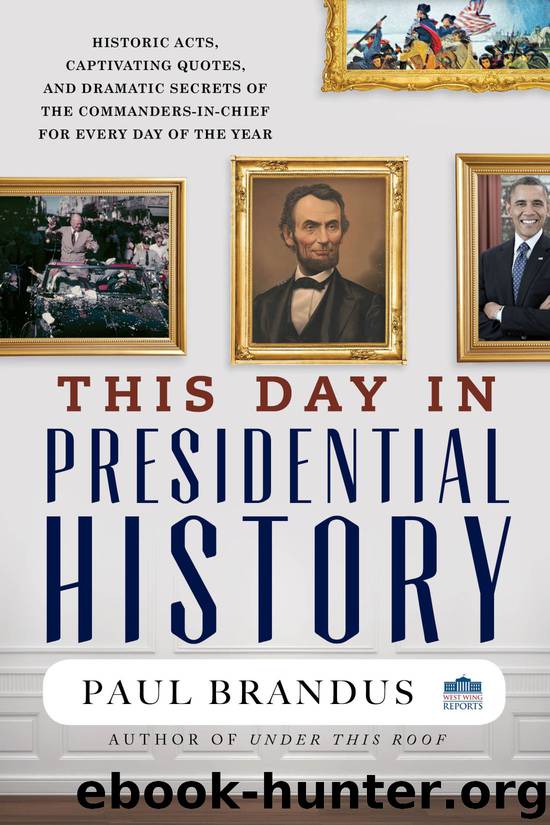
This Day in Presidential History by Paul Brandus
Author:Paul Brandus
Language: eng
Format: epub
Publisher: Bernan Press
Published: 2017-11-06T16:00:00+00:00
Gerald Ford. Official White House portrait.
2015: Barack Obama announced that the United States, Britain, France, Russia, China, and Germany reached a deal with Iran to curb its nuclear program. The deal between the so-called “P5+1” and Iran called for a gradual lifting of energy/financial sanctions in return for Iranian limits on its nuclear production capability. The United States, which continued to name Iran on its list of nations that sponsored terror, said the deal would help ensure that “Iran’s nuclear program is and remains exclusively peaceful.”
Quote of the Day
I have had a lot of adversaries in my political life, but no enemies that I can remember.
Gerald Ford
July 15
1971: A stunning announcement from Richard M. Nixon: he would visit communist China in early 1972. Nixon’s journey to China—arguably the most dramatic trip ever taken by a president— opened the door for increased ties and competition between the two superpowers. It also marked China’s emergence into the modern world, a development of monumental consequence.
1979: Jimmy Carter warned that the United States was threatened by a lack of “moral and spiritual confidence.” He said that this lack of confidence was to blame for an ongoing recession—and was a “fundamental threat to American democracy.” The speech is often referred to Carter’s “malaise” address, though he never actually used that word.
Quote of the Day
Associate with men of good quality if you esteem your own reputation; for it is better to be alone than in bad company.
George Washington
July 16
1790: George Washington signed the Residence Act, a bill authorizing the moving of the nation’s capital from Philadelphia. The new location would be 130 miles to the south along the Potomac River, comprised of land donated by Maryland to the north and Virginia to the south. The area would be called the District of Columbia. It would include the preexisting settlements of Georgetown and Alexandria. In 1846, Congress would return the land originally donated by Virginia. On September 9, 1791, officials overseeing the capital’s construction named the city in honor of President Washington.
1877: Rutherford B. Hayes sent troops to end the Great Railroad Strike of 1877. Workers on the Baltimore and Ohio (B&O) line in Maryland walked off the job after their pay was cut; the strike quickly spread to other states, threatening the economy. After some strikes became violent, the president sent in troops to ensure peace and protect mail delivery.
Quote of the Day
Be courteous to all, but intimate with few, and let those few be well tried before you give them your confidence.
George Washington
The nation’s capital was moved from Philadelphia to the new city of Washington for reasons of national security. In 1783, a group of unpaid soldiers attacked Congress in what came to be known as the Pennsylvania Mutiny of 1783. James Madison argued that the new federal government would need to be located in a new city that the government itself—not a state—controlled. Ironically, Madison would be president when British troops invaded that new city and burned the White House and Capitol to the ground (see August 24).
Download
This site does not store any files on its server. We only index and link to content provided by other sites. Please contact the content providers to delete copyright contents if any and email us, we'll remove relevant links or contents immediately.
| U.K. Prime Ministers | U.S. Presidents |
Waking Up in Heaven: A True Story of Brokenness, Heaven, and Life Again by McVea Crystal & Tresniowski Alex(37813)
Empire of the Sikhs by Patwant Singh(23089)
We're Going to Need More Wine by Gabrielle Union(19051)
Hans Sturm: A Soldier's Odyssey on the Eastern Front by Gordon Williamson(18594)
Leonardo da Vinci by Walter Isaacson(13339)
The Radium Girls by Kate Moore(12033)
Tools of Titans by Timothy Ferriss(8402)
Educated by Tara Westover(8056)
How to Be a Bawse: A Guide to Conquering Life by Lilly Singh(7490)
Permanent Record by Edward Snowden(5851)
The Last Black Unicorn by Tiffany Haddish(5640)
The Rise and Fall of Senator Joe McCarthy by James Cross Giblin(5282)
Promise Me, Dad by Joe Biden(5156)
The Wind in My Hair by Masih Alinejad(5100)
A Higher Loyalty: Truth, Lies, and Leadership by James Comey(4965)
The Crown by Robert Lacey(4818)
The Iron Duke by The Iron Duke(4365)
Joan of Arc by Mary Gordon(4116)
Stalin by Stephen Kotkin(3971)
